Is Your Inflatable Tent Losing Air?

Possible Causes and Solutions for Pressure Loss

All Aerise tents undergo a quality test before delivery. Each tent is set up and tested for pressure loss over a period of 48 hours. If your inflatable tent still loses air, there may be several possible causes.

To identify the cause, carefully inspect the valves and structure after setting up the tent. Below are possible causes of pressure loss and the corresponding solutions.

Push-Push Valves

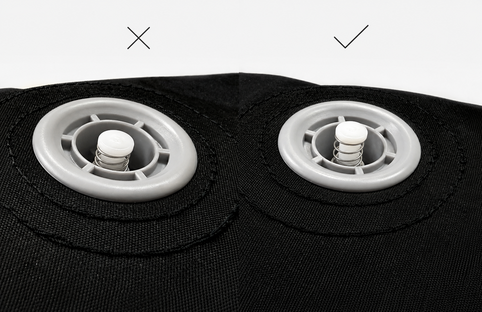
There is a gray or black push-push valve on each tent foot. The valves are opened and closed by pressing the center pin. The valve caps serve only as protective covers.

Only the gray valve is used during setup. This valve is connected to the one-pump system. When disconnecting the pump hose and closing the valve, always make sure that the center pin has not been pushed in. Otherwise, the valve will remain open.


Check the following points to make sure that the black and gray push-push valves are intact and correctly closed.

  • Is the center pin in the middle of the valve pushed out?

    YES: no action required.


    NO: press the recessed center pin until it pops out. The valve is closed only when the pin is in this position. To check whether the closed valve is airtight, hold the supplied piece of fabric in front of it. This will show whether air is escaping from the valve.

  • Is the valve screwed in securely?

    YES: no action required.


    NO: tighten the valve using the supplied valve key.

  • Is there a foreign object inside the valve?
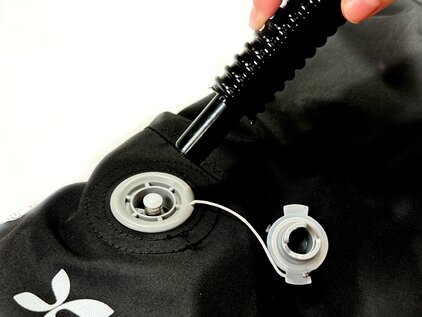
    YES: hold down the center pin and blow out the valve. Point the air pump at the valve from above and switch it on or pump manually. If necessary, the valve can also be shaken and rinsed in water.


    NO: no action required.

  • Is the valve otherwise damaged?

    YES: replace the valve. A replacement valve can be requested and ordered using the Aerise contact form.


    NO: no action required.

Pressure Relief Valves

red pressure relief valve is installed on each tent foot. It regulates the air pressure and prevents the tent from bursting. The pressure relief valves should always remain closed. They do not need to be opened during setup or takedown.


Check the following points to make sure that the pressure relief valves are intact and correctly closed.

  • Is the red pressure relief valve screwed in securely?

    YES: no action required.


    NO: tighten the valve by hand. Please note that the red pressure relief valves should not be opened during takedown either. They must always remain closed.

  • Does the valve have an intact sealing ring?

    YES: no action required.


    NO: replace the valve. A replacement valve can be requested and ordered using the Aerise contact form.

  • Is the sealing surface on the inner air tube intact?

    YES: no action required.


    NO: replace the valve. A replacement valve can be requested and ordered using the Aerise contact form.

  • Is there a foreign object inside the valve?

    YES: press the white cross-shaped seal from the inside and blow out the valve. Point the air pump at the valve from above and switch it on or pump manually. If necessary, the valve can also be shaken and rinsed in water.


    NO: no action required.

  • Is the valve otherwise damaged? (Surface scratches do not affect its function.)

    YES: replace the valve. A replacement valve can be requested and ordered using the Aerise contact form.


    NO: no action required.

Structure

To check whether the tent structure, consisting of the inner air tube and outer sleeve, is intact, inflate each column individually while it is lying flat. Continue until the red pressure relief valve activates, meaning that a whistling sound can be heard or escaping air can be felt.

  • Can escaping air be heard or felt around the valves?

    YES: check the valves as described above.


    NO: no action required.

  • Can escaping air be heard or felt through the fabric along the column?

    YES: replace the inner air tube. A spare tube is included with the tent.


    NO: no action required.

  • Is the tent losing air even though no leakage can be heard or felt around the valves or along the columns?

    YES: contact your Aerise representative to submit a service request.


    NO: no action required.

Have none of the measures worked?

Start a Service Request

If you have been unable to identify the cause of the pressure loss, the tent must be sent in for inspection. Please allow approximately four weeks during which the tent will not be available for use.


How to Return the Tent


  1. Register the return: let us know that you are returning the tent and provide the reason for the service request. You will then receive an ISERV number, which is an internal service number. If the issue is no longer covered under warranty, you will also receive an estimate of the expected costs.
  2. Prepare the package: pack the tent without its accessories in a cardboard box. Write the ISERV number clearly on the outside of the box. This allows us to identify and process your shipment without delay.
  3. Ship the package: send the package to the following address:

    Zingerle Group USA Inc.
    6965 Northpark Blvd, Suite N
    Charlotte, NC 28216
    USA


Once the tent has been received and inspected, we will inform you of the actual costs. These costs must be approved before the service request can be processed further. This applies only if the issue is no longer covered under warranty.


After the repair, the tent undergoes a 48-hour pressure test before being returned to you.

Please contact us if you need further assistance.
Your privacy is important to us
Cookie settings

We use cookies to ensure the reliable and secure operation of our website, to analyze its performance, and to display relevant content to you. You can decide which cookies you want to allow. For more information, please refer to our privacy policy.